Do your friends and loved ones automatically add a 15 minute cushion when they make plans with you? Do you find yourself running late ate least once a day? Do you always end up leaving in the middle of things because you're late for your next appointment?
This kind of chronic lateness can be an energy and productivity killer -- not to mention the damage it does to relationships. Most of my ADD clients are chronically late and fervently wish they could change this about themselves. Those who don't struggle with lateness often don't understand why you don't just get your butt there on time! But it's not always that easy.
Elizabeth Grace Saunders's guest post for LifeHacker has some fantastic suggestions for how to diagnose and treat your particular type of lateness. Check it out here.

Thursday, April 18, 2013

Wednesday, April 17, 2013
Since when does "busy" mean "good"?
I heard a story once about woman who came to this country and was starting to learn English. She was a great observer and a quick learner and, though she wasn't formally educated, she picked up on quite a bit of English pretty quickly. Every time anyone asked her how she was doing she said "really busy" with a smile. After a while it became clear that "really busy" was her automatic response to that questions -- one that she'd learned by listening to those around her*. How many of us automatically say "really busy" when asked about how we are? I know I'm guilty of this sometimes.
But when did "busy" become the culturally valued substitution for "good" (why American's say "good" instead of how they're really feeling is a whole 'nother can of worms!). Why do we value busyness? As a thought experiment: imagine you ask your colleague "how are you doing" and he responds "Taking a break!" or "Not much is going on." What would you think of this person? Why?
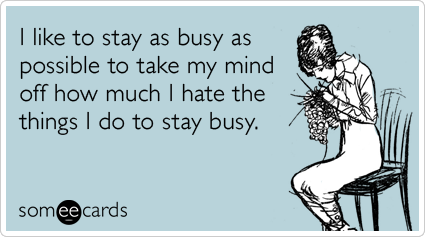
I think busyness is the particular disease of the procrastinator -- and the dissertator, too! Instead of doing our planned tasks for the day and then leaving off for the evening, we spend all day spinning our wheels *wishing* we could get to the important stuff, but instead get nothing done and feel guilty about it all night. Imagine, now, a world where you worked when you wanted to work and then allowed yourself to really take a break when you weren't working. Imagine evenings without guilt when you could proudly announce "I'm taking a well deserved break." Imagine really "powering down" mentally. Pretty great, huh?
But if you know it'd feel great, why isn't that enough to just make it happen? That's a complicated problem -- one that almost always comes up in coaching and one that we can almost always find a solution to! If you find yourself really stuck in this pattern, it might be time to get some help to figure out your own solution! And then get moving toward meeting your goals AND having guilt-free time off.
*I really wish I remember where I heard this story so I could give credit!
But when did "busy" become the culturally valued substitution for "good" (why American's say "good" instead of how they're really feeling is a whole 'nother can of worms!). Why do we value busyness? As a thought experiment: imagine you ask your colleague "how are you doing" and he responds "Taking a break!" or "Not much is going on." What would you think of this person? Why?
I think busyness is the particular disease of the procrastinator -- and the dissertator, too! Instead of doing our planned tasks for the day and then leaving off for the evening, we spend all day spinning our wheels *wishing* we could get to the important stuff, but instead get nothing done and feel guilty about it all night. Imagine, now, a world where you worked when you wanted to work and then allowed yourself to really take a break when you weren't working. Imagine evenings without guilt when you could proudly announce "I'm taking a well deserved break." Imagine really "powering down" mentally. Pretty great, huh?
But if you know it'd feel great, why isn't that enough to just make it happen? That's a complicated problem -- one that almost always comes up in coaching and one that we can almost always find a solution to! If you find yourself really stuck in this pattern, it might be time to get some help to figure out your own solution! And then get moving toward meeting your goals AND having guilt-free time off.
*I really wish I remember where I heard this story so I could give credit!
Wednesday, April 10, 2013
A smooth sea

I found it here http://theraddiaries.tumblr.com/post/46830439595.
Tuesday, April 9, 2013
Depression and academia
Graduate school can be a horribly depressing place. And for those who make it to a tenure track job, the outlook can be equally as bleak. Those in the coaching industry can be guilty of attempting to just jollying up clients. Cheerleading can be great, but it is not a fix for real depression of the sort that over half (!!) of graduate students are struggling with.
Studies have found that graduate school is not a particularly healthy place. At the University of California at Berkeley, 67 percent of graduate students said they had felt hopeless at least once in the last year; 54 percent felt so depressed they had a hard time functioning; and nearly 10 percent said they had considered suicide, a 2004 survey found. By comparison, an estimated 9.5 percent of American adults suffer from depressive disorders in a given year, according to the National Institute of Mental Health. Meanwhile, nearly a quarter of the graduate students surveyed were not aware of mental-health services on the campus. And another Berkeley study recently found that graduate students were becoming increasingly disillusioned with careers in academe and did not view large research institutions as family-friendly workplaces (The Chronicle, January 23)
Why do you think graduate school is such a ripe place for depression?
What to do if you are coping with depression? (1) You can take a screening test here, but also (1) see your doctor. Just your regular old primary care physician can be a great resource. Most campuses also have FREE psychological services. They may not offer long-term care and they may not allow enough sessions with a therapist to get you through to the other side of depression, but they're an excellent place to start. If you're comfortable, ask around. I bet a large percentage of your grad school comrades have also coped with feelings of hopelessness or jags of depression. Some of them may have gotten some help. They are great resources. Those of you (that would be most of you) who have coped with depression, how did you manage? What resources did you draw on? Did your university help or make it worse?
What to do if you are coping with depression? (1) You can take a screening test here, but also (1) see your doctor. Just your regular old primary care physician can be a great resource. Most campuses also have FREE psychological services. They may not offer long-term care and they may not allow enough sessions with a therapist to get you through to the other side of depression, but they're an excellent place to start. If you're comfortable, ask around. I bet a large percentage of your grad school comrades have also coped with feelings of hopelessness or jags of depression. Some of them may have gotten some help. They are great resources. Those of you (that would be most of you) who have coped with depression, how did you manage? What resources did you draw on? Did your university help or make it worse?
The DIY Courtier wrote this fantastic blog post called "21 Tips to Keep Your Shit Together When You’re Depressed." I love how it's both realistic about the paralysis that can come with depression and rich with great ideas on tiny little steps you may want to try. Here are some of my favorites:
- 6) Eat nutritionally sound, regular small meals. If you’re having trouble eating, try to focus on what you’d like to eat. I went through a whole six week episode of tomatoes and cream cheese on a bagel twice a day. Not great, but it was something
- 10) Face a window as often as you can – at work, at home. Look out into the world. Watch. Observe. Try to find something you find pretty or interesting to focus on. And, handily remember that one in five of those people out there feel the way you do.
- 19) Depression will lie to you. Depression will try to tell you what others are thinking. That you are unloved and unworthy, that others think little of you or don’t care – or even wish you harm. You are not a psychic. Keep repeating that. “I am not a psychic”. Repeat. The only way to know what another person is thinking is to up and ask them.
But her whole post is great! And it's a fantastic reminder that depression can not be fixed by pasting a smile on your face. It certainly can not be fixed by just jollying up. I've had lots of clients who work with me as a dissertation coach while at the same time working with a therapist as their mental health professional. Work with the former is often not really realistic until they're working with the later. Take care of yourselves out there.
Monday, April 8, 2013
Busy doing all the wrong things: Procrastination at its best/worst
Alan Henry at Lifehacker says "There's a difference between being always busy and having a lot to do and not enough time to do it in." Read more here: http://lifehacker.com/5992840/
Monday, April 1, 2013
Distraction free writing with writemonkey.com
Sometimes you don't need a fancy-pants 21st century computer. Sometimes you really want something closer to a Commodor 64. WriteMonkey.com can help you with that. It's what Eric Griffith of PCMag calls "the best distraction-free, full-screen, "zen" text editor you'll find for free." For Mac, the equivalent is WriteRoom.com. Both tools are about limiting distractions (and the cognitive fatigue that comes with constantly choosing not to check your twitter feed -- or worse, the distraction of checking it anyway).
We live in a distracting world full of 15 second bites of information. But writing requires sustained attention of the sort that we rarely practice anymore. And it requires frustration tolerance that we usually avoid practicing by distracting ourselves. Notice the vicious circle there? When you're working on developing and sustaining a writing habit, stack the deck in your favor by using a low-distraction tool like writemonkey.com. Or, you know, paper and pencil.

We live in a distracting world full of 15 second bites of information. But writing requires sustained attention of the sort that we rarely practice anymore. And it requires frustration tolerance that we usually avoid practicing by distracting ourselves. Notice the vicious circle there? When you're working on developing and sustaining a writing habit, stack the deck in your favor by using a low-distraction tool like writemonkey.com. Or, you know, paper and pencil.
Get outside, already!
I'm always encouraging my clients to get outside and move! There's all kinds of research showing that "fresh-air breaks" are great for concentration, mood, productivity, etc. Now there's research showing that getting outside in nature (think: green, not: concrete) keeps your brain from getting tired too! Cognitive fatigue is no joke. It's harder to make good decisions when your brain is tired. And it's harder to make yourself do things that you don't feel like doing (think: writing another paragraph, grading another set of papers) when your brain is on empty. So I hope it's sunny and warm where you are -- 'cause it's time you got outside, already!

Brick House Pictures from NYTimes Article
Brick House Pictures from NYTimes Article
Subscribe to:
Posts (Atom)