Friday, October 25, 2013

Delaying gratification involves the imagination, too!

Some interesting research coming from Europe this month (published in PLoS Biology) suggests that the ability to delay gratification might have quite a bit to do with our ability to imagine the future reward.

It works like this: You want to get started with grading that stack of papers, you really do.  But you also want check your facebook page and generally waste some time on the web.  Certainly the reward for getting those papers graded is greater than the reward of finding out what your acquaintances ate for lunch...but it's so far in the future.  It's too far in the future.  And it requires a feat of imagination (and the hippocampus) to fully and richly imagine that distant reward enough that it feels tangible and worth working toward.

This problem is exacerbated when the distant reward we're talking about is for finishing a dissertation or a book.  That's months away.  Years away.  Too far away.

The take home here, as I see it, is that mini-goals are still the way to go: narrow the gap between now and gratification by giving yourself a mini-goal.  But, also, try vividly and imaginatively conjuring up that far-distant reward.  What will it feel like to be done?  What has a similar situation looked like and felt like in the past?  Make it real for yourself.  This might just make that distant reward feel gratifying enough to get started!

Read a summary of the research from the HuffPost here:
http://www.huffingtonpost.com/2013/10/24/delay-gratification-brain-hippocampus_n_4144613.html


[This image is from Keith Beaty of the Toronto Star.  It depicts that old executive functioning test for measuring delay of gratification: The Marshmallow Test.  It's an oldie but goodie.  You can learn some more about this test below -- it's funny!]


Thursday, October 10, 2013

Focus@Will: New app for those who love listening to music while they work

When I work with high school students, there's one disagreement I usually find my self negotiating between parents and teens: Is it "good" to listen to music while studying?  Parents say "no" -- teen says "yes."

There are two pieces to my answer.

(1) This is a losing battle for parents because many students truly believe they work best while listening to music & there is little we can tell them to change their minds.  Besides, short of policing their study time, how would we make them stop?

(2) Listening to all types of music during every sort of study session is NOT bad for memory.  There's some good (and intuitive) research to show that listening to novel, message-heavy music while reading or working hard to understand new material isn't good for retention.  But listening to old, easy to tune out, mostly instrumental music while studying kind of boring material could be just the ticket for maintaining focus.

In these circumstances, I work with students to help them think about what kinds of music will help them under what circumstances -- and under what circumstances they'll be doing themselves a favor by creating silence.

Many of my graduate student and academic clients have found that they do their best work in coffee shops and there's even a site (which I reviewed here) dedicated to helping you recreate that perfect coffee shop sound environment.

Now there's a new app called Focus@Will (free trial & then $4/month) that streams music that claims to enhance one's ability to focus on tasks.  It's a steep price tag, in my opinion, but I tried a few 60-minute sessions & it did seem to help!  It also makes a handy timer for those of you working in short-bursts (a la the Pomodoro Technique).  From what I experienced, Focus@Will streams mostly classical music, so it may not appeal to everyone.  But it may hit the sweet spot for those who don't like working in total silence, but don't want to take the time to find the "right" sort of music to help them stay at work.


Tuesday, October 8, 2013

10 research-based tips for studying smarter

The British Psychology Society lists 10 research-based tips for studying smarter, including testing yourself as part of studying (which I'm always going on about with my clients) & getting the lecture notes before the lecture when possible.  There are lots of other good ones listed.
The best part: you can sign up for a "fortnightly email"-- ah British English.  I love it!

Procrastination: The science behind why we do it and how to stop!

It's all about temporal discounting: Imminent rewards seem way more valuable to the primitive reward centers in our brains.  The solution: reward yourself in small intervals & set deadlines.  You wouldn't make your puppy wait until the end of the training session to get his treat, and you shouldn't make yourself wait either.
This video has some other great tips, too!


Thursday, September 12, 2013

Cookie Monster with an important message about self-control

Having trouble turning off Orange is the New Black and getting back to editing that lit review? Cookie monster has a catchy message for you!  (Just try not to get this stuck in your head.)

Friday, June 21, 2013

Accessorize your coffee shop study halls

From http://www.theliterarygiftcompany.com/go-away-im-writing-bone-china-mug-1589-p.asp

We knew it all along: Coffee shops are great places to work

This will come as absolutely no surprise to my dissertation clients: It turns out coffee shops can be great places to work!  <Shocker>

But why do the grad students get all the productivity?  What about undergrads (many of whom have caught on just fine on their own)?  More to the point, what about the faculty??
For those faculty members who used to do their best work in coffee shops, why have you stopped?  Many abandon the coffee shops (except maybe on weekends or sabbaticals).  If coffee shops used to work for you, are there ways you can reincorporate what worked about that setting into your daily faculty life?  I have yet to find a campus without a coffee shop within walking distance.  Can you schedule a one hour writing date several times a week (or once) with yourself and a cup of coffee?

The NYTimes article I've linked to actually presents research on background noise, not coffee shops per se.  And it doesn't suggest that background noise is great for all kinds of thinking: "extreme quiet tends to sharpen your focus, which can prevent you from thinking in the abstract."  So keep in mind that the right level of noise is specific to the task.

While a walk to a coffee shop is probably a fantastic idea for mood & concentration, if it's not in the cards, how might you instead build that optimal level of background noise (around 70 db it seems) in your office during writing time?  Keep in mind, this should be background noise...not music you're tempted to sing along with or really listen to.  Perhaps a white noise machine, or instrumental music that's really background music for you?  Or if you're waiting for the white noise app with a coffee shop setting -- the wait is over!  You really can find everything on the Internet.

image from Coffitivity.com

Wednesday, June 19, 2013

Summer "Vacation"

What are you planning on doing with your summer vacation?  For so many in academia, summer slips by on a warm breeze and before you know it all those lofty goals are pushed to winter break.  Or next summer.  Summers and sabbaticals are the toughest times for my clients -- not because they're so busy but because, paradoxically, their days aren't busy enough.  Or at least not structured enough.  Coaching can help with the structure.  But for some people (particularly the sort with tenure), the best decision is to plan for some real, honest-to-goodness, vacation time.  I'm talking about the kind of vacation that the outside world assumes we're all taking anyway.  You can read an account of just such a decision here: http://www.insidehighered.com//blogs/college-ready-writing/what-im-choosing-do-my-summer-vacation

Wednesday, May 15, 2013

Dreaming big

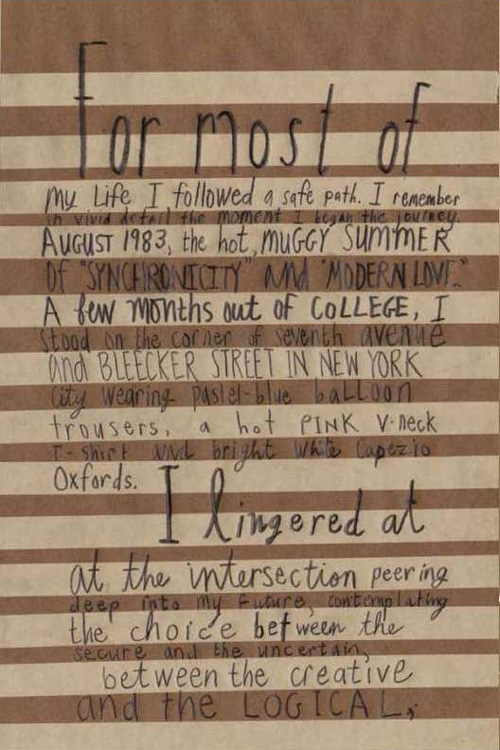
Tis the season for inspirational commencement addresses.  This one, illustrated beautifully by Debbie Millman, actually gave me the chills:

Read the rest here. http://www.brainpickings.org/index.php/2013/05/15/debbie-millman-look-both-ways-fail-safe/.  This page, above, is just the warm up...it gets great on page 4. My favorite part: "We begin by worrying that we're not good enough, smart enough, or talented enough to get what we want, then we voluntarily live in this paralyzing mental framework, rather than confront our own role in this paralysis. Just the possibility of failing turns into a dutiful self-fulfilling prophecy.  We begin to believe that these personal restrictions are in fact, the fixed limitations of the world."

This comes via www.brainpickings.org/.  None of us needs another place to waste time on the internet, but Brain Pickings is curated by Maria Popova.  There's only one new thing a day.  And it's excellent.

Monday, May 6, 2013

Daily rituals keep famous writers on track... and they can help you too!

I'm constantly pitching the virtues of daily writing rituals with my academic clients.  Rituals help you short circuit the planning/prioritizing/fretting part of your brain and skip straight to the doing.  One client I worked with several years ago had a very complex writing ritual that involved two cups of coffee, just so, 10 minutes of free writing, 5 minutes of non-writing reflection, several minutes of consulting her list of upcoming tasks, and then...and only then...did she get started with the meat of the writing.  It seems like quite a circuitous route to get to the task for the day, but it really only took about 20 minutes and it prevented the anxiety that usually accompanied her writing.  By preventing anxiety, she prevented procrastination.  Imagine if you could run a 20 minute getting-ready script and then get right to your writing.  Doesn't that sound better than the 2 hours of whatever the heck you're doing instead of writing?

I believe the human mind craves regularity & deplores too much choice.  Let's make it comfortable to creating routines that facilitate our higher goals!

My fascination with writing rituals makes me especially delighted to find this: http://dailyroutines.typepad.com/
It's a whole blog devoted to highlighting famous writers' rituals, some of which make my past client's look incredibly mundane!

Here's Steven King's:

(Thanks to St. Martin’s Press/Thomas Dunne Books.)

Thursday, April 18, 2013

Chronic lateness: What's the cause and how can you fix it?

Do your friends and loved ones automatically add a 15 minute cushion when they make plans with you?  Do you find yourself running late ate least once a day?  Do you always end up leaving in the middle of things because you're late for your next appointment?

This kind of chronic lateness can be an energy and productivity killer -- not to mention the damage it does to relationships.  Most of my ADD clients are chronically late and fervently wish they could change this about themselves.  Those who don't struggle with lateness often don't understand why you don't just get your butt there on time!  But it's not always that easy.

Elizabeth Grace Saunders's guest post for LifeHacker has some fantastic suggestions for how to diagnose and treat your particular type of lateness.  Check it out here.

Wednesday, April 17, 2013

Since when does "busy" mean "good"?

I heard a story once about woman who came to this country and was starting to learn English.  She was a great observer and a quick learner and, though she wasn't formally educated, she picked up on quite a bit of English pretty quickly.  Every time anyone asked her how she was doing she said "really busy" with a smile. After a while it became clear that "really busy" was her automatic response to that questions -- one that she'd learned by listening to those around her*.  How many of us automatically say "really busy" when asked about how we are?  I know I'm guilty of this sometimes.

But when did "busy" become the culturally valued substitution for "good" (why American's say "good" instead of how they're really feeling is a whole 'nother can of worms!).  Why do we value busyness?  As a thought experiment: imagine you ask your colleague "how are you doing" and he responds "Taking a break!" or "Not much is going on."  What would you think of this person?  Why?


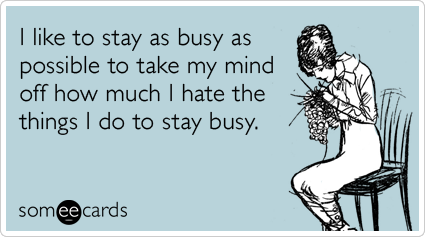
I think busyness is the particular disease of the procrastinator -- and the dissertator, too!  Instead of doing our planned tasks for the day and then leaving off for the evening, we spend all day spinning our wheels *wishing* we could get to the important stuff, but instead get nothing done and feel guilty about it all night.  Imagine, now, a world where you worked when you wanted to work and then allowed yourself to really take a break when you weren't working.  Imagine evenings without guilt when you could proudly announce "I'm taking a well deserved break."  Imagine really "powering down" mentally.  Pretty great, huh?

But if you know it'd feel great, why isn't that enough to just make it happen?  That's a complicated problem -- one that almost always comes up in coaching and one that we can almost always find a solution to!  If you find yourself really stuck in this pattern, it might be time to get some help to figure out your own solution!  And then get moving toward meeting your goals AND having guilt-free time off.


*I really wish I remember where I heard this story so I could give credit!

Wednesday, April 10, 2013

A smooth sea


I love this.  It's going to be my mantra on days when writing seems so hard.
I found it here http://theraddiaries.tumblr.com/post/46830439595.

Tuesday, April 9, 2013

Depression and academia

Graduate school can be a horribly depressing place.  And for those who make it to a tenure track job, the outlook can be equally as bleak.  Those in the coaching industry can be guilty of attempting to just jollying up clients.  Cheerleading can be great, but it is not a fix for real depression of the sort that over half (!!) of graduate students are struggling with.

Studies have found that graduate school is not a particularly healthy place. At the University of California at Berkeley, 67 percent of graduate students said they had felt hopeless at least once in the last year; 54 percent felt so depressed they had a hard time functioning; and nearly 10 percent said they had considered suicide, a 2004 survey found. By comparison, an estimated 9.5 percent of American adults suffer from depressive disorders in a given year, according to the National Institute of Mental Health. Meanwhile, nearly a quarter of the graduate students surveyed were not aware of mental-health services on the campus. And another Berkeley study recently found that graduate students were becoming increasingly disillusioned with careers in academe and did not view large research institutions as family-friendly workplaces (The Chronicle, January 23)

Why do you think graduate school is such a ripe place for depression?

What to do if you are coping with depression?   (1) You can take a screening test here, but also (1) see your doctor.   Just your regular old primary care physician can be a great resource.  Most campuses also have FREE psychological services.  They may not offer long-term care and they may not allow enough sessions with a therapist to get you through to the other side of depression, but they're an excellent place to start.  If you're comfortable, ask around.  I bet a large percentage of your grad school comrades have also coped with feelings of hopelessness or jags of depression.  Some of them may have gotten some help.  They are great resources.  Those of you (that would be most of you) who have coped with depression, how did you manage?  What resources did you draw on?  Did your university help or make it worse?

The DIY Courtier wrote this fantastic blog post called "21 Tips to Keep Your Shit Together When You’re Depressed."  I love how it's both realistic about the paralysis that can come with depression and rich with great ideas on tiny little steps you may want to try.  Here are some of my favorites:
  • 6)  Eat nutritionally sound, regular small meals. If you’re having trouble eating, try to focus on what you’d like to eat. I went through a whole six week episode of tomatoes and cream cheese on a bagel twice a day. Not great, but it was something 
  • 10)  Face a window as often as you can – at work, at home. Look out into the world. Watch. Observe. Try to find something you find pretty or interesting to focus on. And, handily remember that one in five of those people out there feel the way you do.
  • 19)  Depression will lie to you. Depression will try to tell you what others are thinking.  That you are unloved and unworthy, that others think little of you or don’t care – or even wish you harm. You are not a psychic. Keep repeating that. “I am not a psychic”.  Repeat. The only way to know what another person is thinking is to up and ask them.
But her whole post is great!  And it's a fantastic reminder that depression can not be fixed by pasting a smile on your face.  It certainly can not be fixed by just jollying up.  I've had lots of clients who work with me as a dissertation coach while at the same time working with a therapist as their mental health professional.  Work with the former is often not really realistic until they're working with the later.  Take care of yourselves out there.  

Monday, April 8, 2013

Busy doing all the wrong things: Procrastination at its best/worst

Alan Henry at Lifehacker says "There's a difference between being always busy and having a lot to do and not enough time to do it in."  Read more here: http://lifehacker.com/5992840/

Monday, April 1, 2013

Distraction free writing with writemonkey.com

Sometimes you don't need a fancy-pants 21st century computer.  Sometimes you really want something closer to a Commodor 64.  WriteMonkey.com can help you with that.  It's what Eric Griffith of PCMag calls "the best distraction-free, full-screen, "zen" text editor you'll find for free."  For Mac, the equivalent is WriteRoom.com.  Both tools are about limiting distractions (and the cognitive fatigue that comes with constantly choosing not to check your twitter feed -- or worse, the distraction of checking it anyway).  

We live in a distracting world full of 15 second bites of information.  But writing requires sustained attention of the sort that we rarely practice anymore.  And it requires frustration tolerance that we usually avoid practicing by distracting ourselves.  Notice the vicious circle there?  When you're working on developing and sustaining a writing habit, stack the deck in your favor by using a low-distraction tool like writemonkey.com.  Or, you know, paper and pencil.

Get outside, already!

I'm always encouraging my clients to get outside and move!  There's all kinds of research showing that "fresh-air breaks" are great for concentration, mood, productivity, etc.  Now there's research showing that getting outside in nature (think: green, not: concrete) keeps your brain from getting tired too!  Cognitive fatigue is no joke.  It's harder to make good decisions when your brain is tired.  And it's harder to make yourself do things that you don't feel like doing (think: writing another paragraph, grading another set of papers) when your brain is on empty.  So I hope it's sunny and warm where you are -- 'cause it's time you got outside, already!


Brick House Pictures from NYTimes Article

Wednesday, March 27, 2013

Do more by planning to do less

Writing is one of those metaphorical mountains that can seem really really high.  It seems paradoxical when you weren't able to get started yesterday that the way forward is to do LESS.  But this is often the case when we're dealing with a task that we've built up so big.

Has this every happened to you: you weren't able to get yesterday's tasks done so you added those tasks to today's list, making today's to-do list even more insurmountable?  I see this all the time with clients -- particularly those who are working on dissertation writing or other independent writing tasks.

If you were stuck yesterday, look at what you planned to do, what you "should  have gotten done," and cut it in half.  Make that your to-do item for today.  

Have you been stuck for weeks or months?  You CAN NOT make up for lost time today.  Instead, make this your task for today: free write about anything for 5 minutes.  Or 2 minutes is you feel yourself resisting 5 minutes.  Or 1 minute if you feel resistance toward 2 minutes.  Just get that pen on paper (or fingers on keyboard) and write. 

Friday, March 8, 2013

Does this sound familiar to any procrastinators out there?

What's poor Lev doing wrong?  What would you tell him to do differently?  What would you tell yourself!?

What's 750words.com all about?

Writers, dissertators, academics!  How have I gone this long without sharing 750words.com?  I'm always talking about lowering the stakes for first drafts (zero drafts).  And 750words is a tool designed to help with just that.  It's perfect for those of you who start writing with free-writing.  And even more perfect for those of you who are working on establishing a daily writing habit.

Here's the general idea: 750 words = about 3 pages.  You head to 750word.com & log in.  750words will open a new blank page for the day and you get writing.  It tracks your number of words and saves your writing.  It lets you know how many days you've met your goal.  It's a very simple text editor so you can't get too caught up in formatting.  You just write.  Simple.  Right?  

Wednesday, February 20, 2013

Dealing with low frustration tolerance

Low frustration tolerance is tantamount to setting a low bar for how much boredom or frustration you're willing to accept in order to reach your goals -- in other words, giving up too soon when the going gets tough.  Low frustration tolerance is that little voice in the back of your head that shouts:
Most of us can relate to this.  Certainly, we've all wanted to give up when a project goes "into the weeds" or we're not accomplishing our goals as quickly as we'd like.

But low frustration tolerance is linked with procrastination, depression, anger, anxiety, and, of course, giving up before we reach our goals -- especially when those goals are excellent and far reaching and difficult.

Unless you're reaching for mediocre, it's worth making a concerted effort in working toward higher frustration tolerance.  And the good news is that this effort is pretty straight forward (if slightly uncomfortable... but that's the point).

Most advice on how to increase your ability to tolerate frustration centers around two interlinked strategies:

  • Gradual exposure to slightly greater levels of frustration -- and realizing it didn't kill you -- can strengthen your frustration tolerance "muscle"
  • Reframing your irrational beliefs about the level of discomfort associated with frustration.  For example, change your self-talk from "This is impossible and I can not stand working on it another minute" could be swapped for "This is really uncomfortable & I don't like it, but I can stand this bad feeling."  If you're helping your kid on this, have them practice reframing statements out loud.  More to try: "This is not the end of the world," or "I don't like this, but I can deal with it," or "This is annoying or a pain in the butt, but it's bearable."
Below are many links from around the internet on strategies for building your ability to tolerate those daily frustrations:
Practice make us stronger and this is never more true then when we're practicing tolerating daily frustrations.  Luckily, there are hundreds of little opportunities every day to practice.

Wednesday, February 13, 2013

Great video on the science of getting stuff done


I love this video because it's not trying to sell anything & is based on the science of motivation and productivity.  Clear 3 minutes in your schedule and watch!


Anything there you found useful?  Anything you'd like to see more of in the future?

Tuesday, February 12, 2013

Goal setting: the first step to goal achieving

“Whenever you want to achieve something, keep your eyes open, concentrate and make sure you know exactly what it is you want. No one can hit their target with their eyes closed.” 
― Paulo CoelhoThe Devil and Miss Prym

It's tough to achieve goals when we don't know what they are.  Many (if not most) of my clients come to their first session with some goals in mind, but often those goals are still a little fuzzy or not completely in focus.  Goal setting is tough.  I think it's tough because (1) it's a skill we haven't practiced much and because (2) once we articulate very clear, measurable goals then we feel like there's a chance we might fail.  If our goals stay fuzzy we don't have to face the possibility of failing to reach them.  But here's the rub: we also are less likely to achieve what we really want!  We have to be brave enough to say what we're aiming for so that we have a chance of hitting the target.  And we're more likely to seek out the support (like coaching) that will get us there.  Paulo Coelho says it well: “Whenever you want to achieve something, keep your eyes open, concentrate and make sure you know exactly what it is you want. No one can hit their target with their eyes closed.” 


<reposted from OnTrack News>

Amy Poehler on Stress

Amy Poehler's Smart Girls channel is my new favorite YouTube obsession.  Sure, technically it's for pre-teen and teenage girls, but Amy & Co. are so awesome that I feel like they're talking to me too.  In this "Ask Amy" episode she talks about how to manage stress -- and she references Anne Lamott (another favorite sage).  Check it out!

<reposted from OnTrack news>

Tentative links between food colorants and hyperactive behavior

A very preliminary review of the literature (okay, truth: I've only checked the WebMD site) hints as links between food colorants and hyperactive behavior.  What this means: while hyperactive behavior isn't the same thing as ADHD, and while the links are tentative and have only been demonstrated in the short term, cutting out food colorants on a trial basis is certainly worth a shot.  Depending on how heavily your family's diet currently leans toward convenience foods, it might not be all that difficult to set a 2 week trial period and see if you notice any change in behavior.  

Try this first: Based on common sense, but not yet based on hard science, I recommend starting with breakfast.  Check labels on what you and your kids are eating for breakfast.  First, just notice whether or not there are food colorants on the ingredient list.  No?  Good for you!  Yes?  That gives you something to work with!  Commit to 2 weeks of colorant free breakfast and see if that makes a difference.  Consider it your own little experiment.  Unless you have a real Fruit Loops addict on your hands, it can't do any harm to try.  Let me know how it goes!

<reposted from the OnTrack Academic News Feed>

Rituals to keep your day running smoothly


What daily rituals do you already have?  How do they make your life easier?

Rituals are powerful because they automate our behavior and decrease the "activiation energy" required to accomplish a task.  In other words, they make it easier and less brain-intensive to get things done.  Think of a ritual as a routine -- you have a ritual for brushing your teeth, you have a ritual for making your morning coffee, you have a ritual for fixing your normal breakfast.  If you're like me, you have to make a routine of these early morning tasks because there's not a lot of cognitive "cycles" to go around first thing in the morning.  If I didn't have a script to run, I might never get out the door.  Consider brushing you teeth: you don't have to think about it; you just reach for the toothpaste and do your thing, just like you've done a million times before.  Rituals are all about taking decision making out of the picture.  Removing the need to make decisions can be powerful for a lot of reasons.  It short circuits anxiety & reduces cognitive load.  I recommend that my clients use rituals as powerful tools in many situations.  

For example, those of you with a fear-of-writing (very common among "dissertating" clients) - try creating a writing ritual so that your cognitive baggage can't get between you and those first words.  A writing ritual might look like this: fix a cup of tea, open computer, pull out notes from yesterday, compose first sentence on scrap paper, type in first sentence, and you're started!  

My clients with ADHD often have trouble getting out of the door in the morning.  Here again, there's the double whammy of attentional deficits and early morning brain fog.  Try creating rituals for particularly sticky parts of the morning routine.  Write them down.  Follow them to a "T" for 3 or 4 weeks and see if that small part of the morning doesn't get a little smoother.  A ritual I just added for myself is putting together my workbag the night before.  You've heard this tip in the past, I'm sure.  But now I set it by the front door with my keys and shoes.  This might also be old hat.  But I add one more step: I create a little pile of everything that needs to leave the house with me right there by the front door.  As I'm putting the house to bed the night before I often remember library books that need to be returned, grocery lists that need to be consulted, etc.  If these aren't in my pile the night before there's little chance I'll remember them in the morning.  

What are the sticky parts of your morning?  What rituals can you make to help them run more smoothly?


<reposted from the OnTrack Academic News Feed>

How we decide when to take a break...and when to persist

Time Magazine has an interesting piece about some research (led by Mathias Pessiglione of the Motivation Brain and Behavior Laboratory of INSERM in Paris, France) on how people decide when they need a break and when they're willing to persist.

The most interesting part, for me, is that we're willing to persist longer when we value the reward or when we think the task isn't that hard anyway.  This has interesting implications for motivating ourselves to keep at it, even when we'd rather stop and check Facebook.  In what ways can you shift your focus toward thinking about the payoff?  Or break the task into smaller pieces so it doesn't seem so darn hard?
"The peaks and valleys that trigger these [quitting or persisting] decisions are not pre-set:  they’re influenced by how much effort you’re expending and how big a reward you expect from the work.  The bigger the reward and the smaller the effort required, the more likely you are to keep going until you’ve done what needs doing.  As you work, it seems, your brain continuously calibrates your breaking point in relation to your expectations of gain."

Read more: http://healthland.time.com/2013/01/31/how-your-brain-tells-you-when-to-take-a-break/#ixzz2K2yvwPNg


<reposted from the old OnTrack Academic News Feed>

Why a to-do list feels so darn good

This interesting article from BBC News by Tom Stafford focuses mainly on the Getting Things Done system (which a lot of people love -- but many find overwhelming and difficult to maintain).  The most interesting bit in this article, though, is the following research tidbit about why unfinished tasks needle us & what to do about it:

"People did worse on a brainstorming task when they were prevented from finishing a simple warm-up task – because the warm-up task was stuck in their active memory. What Baumeister and Masicampo did next is the interesting thing; they allowed some people to make plans to finish the warm-up task. They weren't allowed to finish it, just to make plans on how they'd finish it. Sure enough, those people allowed to make plans were freed from the distracting effect of leaving the warm-up task unfinished."

<reposted from the old OnTrack Academic News Feed>

Making good habits easier


"Look at the good habits you want to develop and see if there’s a way you can make them easier to begin by 20 seconds. Want to stop a bad habit? Increase the time it takes to initiate it by 20 seconds."  

Is the “20 second rule” the key to being your best?

New location for OnTrack Academic Coaching news

I'm moving my OnTrack Academic News feed to a blog format so that folks can leave comments.  I hope this will allow clients and others from around Internetland to interact with me in a more fluid way!  See you here!